Technical Articles
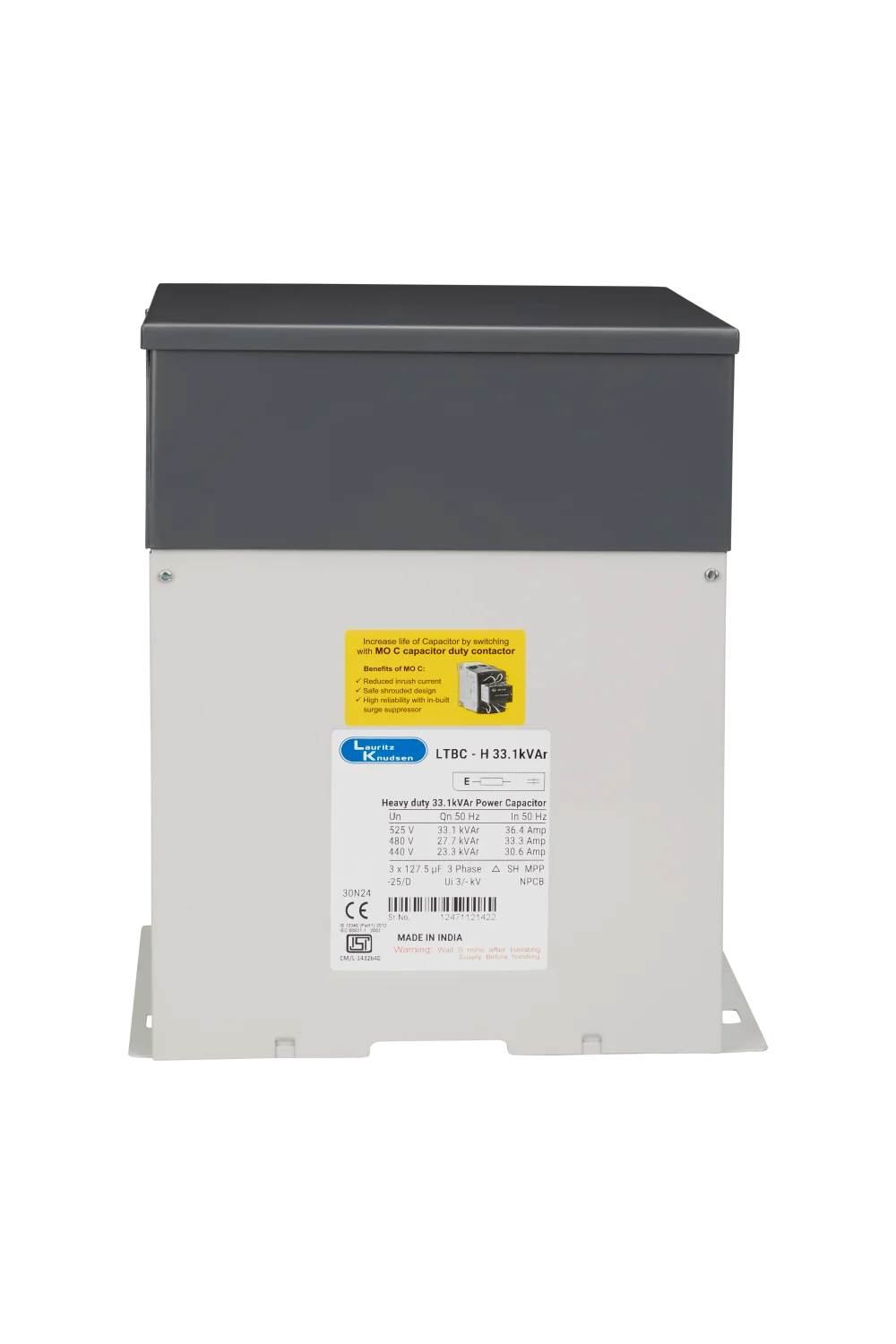
The life of a capacitor is influenced by the following three parameters:
For a capacitor, the temperature depends upon the following parameters:
The increase in temperature results in faster degradation of the dielectric. For every 10°C rise in temperature, the life of the capacitor is halved. Faster the degradation of the dielectric, lower will be the life of the capacitor.
Increase in temperature beyond a certain limit may result in expansion of impregnation and dielectric material. This may result in bulging of capacitors. In worst case, capacitor may even burst, if it does not have an over-pressure disconnector.
The capacitor must thus be operated at rated ambient temperature for a long operating life.
Capacitors are classified in temperature categories, each category being specified by a number followed by a letter. The number represents the lowest ambient air temperature at which the capacitor may operate. The letters represent upper limits of temperature variation ranges.
Letter symbols for upper limit of temperature range as per IEC 60831 are as follows:
| Symbol | Ambient Temperature | ||
| Maximum | Highest mean over any period of | ||
| 24 h | 1 year | ||
| A | 40 | 30 | 20 |
| B | 45 | 35 | 25 |
| C | 50 | 40 | 30 |
| D | 55 | 45 | 35 |
The increase in system voltage has the following effects on the capacitor:
- Dielectric degradation
If the voltage increases beyond a certain limit, the dielectric material will breakdown. This critical voltage is called the dielectric breakdown voltage. Breakdown can result in an internal short circuit causing the capacitor to fail permanently.
- Increase in current flow through the capacitor
As capacitors are linear in nature, with increase in voltage, the capacitor current also increases because XC remains constant (IC = V/XC). This results in overloading of the capacitor, which may reduce the life of the capacitor. Over voltage limits of the capacitors are +10% for 8 hrs in 24 hrs, +15% for 30 min in 24h, +20% for 5 min in 24 hrs and +30% for 1 min in 24 hrs.
A generally accepted formula for estimating life of capacitor is:

Where:
L = Operating Life Under Stated Temperature and Voltage LR = Life at Rated Temperature & Voltage
ER = Rated Voltage Limit EO = Operating Voltage
ΔT= Difference between Rated Operating Temperature & Capacitor Core Temperature in C.
The parameters that are related to current, which affect the life of the capacitor are:
- Inrush current
Whenever the capacitor is switched on, it draws a huge inrush current which goes up to levels even greater than 100 times the capacitor rated current. Frequent switching of the capacitor without proper inrush current limiting devices will affect the life of the capacitor as it is heavily stressed during each switching operation. Switching frequency and amplitude of inrush current thus influences the life of the capacitor.
- Over-load current
Continuous overload of capacitor is mainly because of harmonics and continuous over voltage. Overloading results in local hot spots and may lead to an internal short circuit.
To conclude, all the above parameters should be within the rated value in order to exploit the maximum life of the capacitor.

Abhinav L Purkar,
Manager Product Management & Marketing (PMM)Abhinav Purkar is a Product Management, Marketing, and Application Engineering professional with over 10 years of experience in the Power Quality domain. He has extensive expertise in power quality analysis, harmonic mitigation, reactive power compensation, energy efficiency, and electrical system optimization, helping customers improve system reliability and operational performance. With proven experience in product lifecycle management, market development, portfolio growth, and go-to-market strategy, Abhinav has successfully driven initiatives that enhance customer value and strengthen market presence. His strong technical foundation, combined with strategic business acumen, enables him to bridge the gap between customer requirements and innovative product offerings.
Assistance Required?
Select an option to Contact Us
 Contact Us


