Technical Articles
Modern facilities run on sensitive electronics, variable frequency drives, and other non-linear loads. These devices quietly distort the electrical waveform. Good monitoring catches that distortion early, before it causes downtime or penalties. This article covers the two standards that govern harmonics worldwide, the hardware used to track them, and how industrial power quality solutions keep facilities in lasting, provable compliance.
Ask any plant electrician about the day a transformer started humming louder than usual. Chances are, nobody had been watching the harmonics. Power problems do not announce themselves. They build slowly, in the background, until a breaker trips for no obvious reason. Or a utility bill lands with a penalty line item nobody expected. That's what this article is really about.
Why do voltage and current distortion matter? What the governing standards actually require? And how the right monitoring setup keeps a facility compliant, efficient, and mostly free of nasty surprises? Read this blog to find it all.
Grids everywhere are absorbing more variable frequency drives, LED lighting, and switch mode power supplies than they were ever built for. Each device pulls current in a slightly irregular way. Add it all up, and that irregularity becomes a real problem. So regulators and utilities responded. They wrote rules that define acceptable limits for distortion, sags, and imbalance. The result is a shared language. Engineers everywhere can now agree on what "clean power" actually means.
Power quality monitoring is the continuous tracking, measurement, and analysis of voltage, current, and frequency to keep a system reliable and compliant with recognised electrical standards.
Invisible electrical problems get expensive fast. Overheating transformers wear out quietly, year after year. Nuisance breaker trips stop production at the worst possible moment. Insulation breaks down faster than it should under harmonic stress. Utilities issue penalties for low power factor or excessive distortion. And eventually, all of it adds up to downtime nobody budgeted for.
Two frameworks dominate this space. People confuse them often, even though they solve different problems. In reality, one sets harmonic current and voltage limits inside a power system. The other covers a much wider net: emissions, immunity, and how you actually measure any of it.
The IEEE 519 standard sets harmonic distortion limits at the Point of Common Coupling. That's the boundary where a utility hands off responsibility to its customer. Think of it as a fence line. The standard tracks two things separately: Total Voltage Harmonic Distortion (THD_V) and Total Demand Distortion of current (TDD_I). Mixing these two up is one of the most common mistakes engineers make on site.
IEEE 519 is a recommended practice that establishes harmonic control guidelines. Utilities, consultants, and project specifications may adopt these limits as contractual or project-specific requirements.
This one is actually a family of documents, not a single rulebook. It covers emissions, immunity, and the measurement techniques used to verify both. Its reach goes well beyond harmonics. It touches flicker, voltage dips, and transient behaviour across a wide range of equipment. A facility might reference several parts of the same family at once. One part for testing equipment emissions, another for verifying instrument accuracy. A comprehensive power quality program also evaluates voltage unbalance, flicker, sags, swells, transients, and interruptions alongside harmonic distortion.
Compliance certificates and accredited laboratory test reports provide independent verification that monitoring equipment meets applicable IEC measurement standards. For measurement systems used in regulated, contractual, or compliance-related applications, documented test results and certification from recognised or accredited bodies provide evidence that the equipment meets the required performance criteria.
Once you understand the standards, the harder question is practical. What actually goes on the plant floor? Good correction hardware works alongside equipment that simply watches the waveform. Industrial power quality solutions usually layer several technologies together. Why? Because a facility running VFDs, welders, and large motors rarely has just one source of distortion. The goal is simple: filter what you can, correct what you should, and protect what you can't fully control.
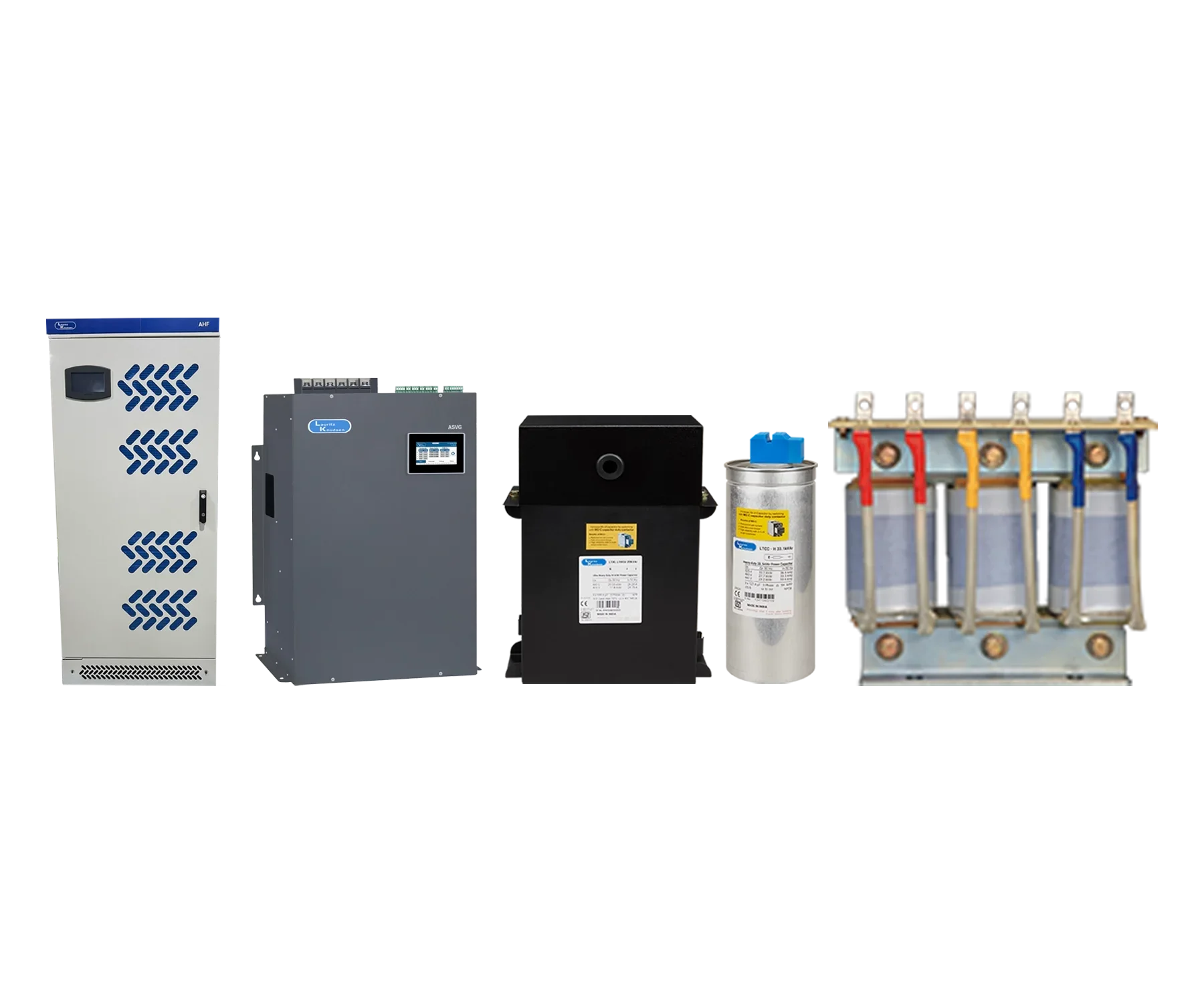
Non-linear loads like VFDs, inverters, and LED drivers all generate harmonic currents. Those currents ripple straight back into the supply. Passive filters handle steady, predictable distortion well, and cheaply. Active harmonic filters (AHFs) go further. They inject a correcting waveform in real time, so they adapt to fluctuating loads much better. For facilities with highly variable non-linear loads, active harmonic filters often provide greater flexibility in achieving and maintaining IEEE 519 harmonic control guidelines.
Low power factor costs money quietly, even when nothing looks broken. Power factor correction capacitor banks push apparent power closer to the real, useful power a facility actually consumes. Detuned reactors usually pair with these banks. Why? To avoid resonance with existing harmonics, a common and costly mistake when capacitors go in without proper tuning. Done right, this one upgrade often pays for itself within a couple of years.
Sensitive processes can go offline in a fraction of a second. Think semiconductor lines or pharmaceutical batching. A single voltage dip is enough. Dynamic Voltage Restorers (DVRs) inject compensating voltage during a sag to support sensitive loads. They are typically deployed in critical facilities where voltage sags can result in significant production or operational losses. Surge protective devices (SPDs) handle the opposite problem. They clamp transient spikes before those spikes reach sensitive electronics. Together, the two cover both ends of the disturbance spectrum.
A monitoring system is really a hierarchy, not one device bolted onto a switchboard. At the top sits precision metering that satisfies legal and contractual requirements. Further downstream, cheaper meters track trends without needing certified accuracy. And tying it all together is an analytics layer that turns raw waveform data into something an engineer can actually use. Get this hierarchy right, and a facility stops reacting to problems. It starts anticipating them, well before they turn into downtime.
Where utility power enters the facility, Class A instruments compliant with IEC 61000-4-30 are typically recommended for revenue-grade and compliance-related measurements. This is the equipment often used for detailed event capture and measurement verification during power quality assessments.
Class S meters cost less and measure a little less precisely than Class A units. That's fine for sub-panels scattered around the plant. They won't settle a legal dispute, but they're excellent at spotting which branch circuit is generating harmonics or drawing odd current. Place them near suspect loads, and they narrow down internal problems long before those problems spread facility-wide.
Raw waveform data sitting unread in a meter's memory is useless. Cloud platforms now automate report generation for IEEE 519 standard audits. Edge analytics go further, flagging anomalies the moment they happen, not days later. Advanced analytics can help identify emerging power quality trends and abnormal conditions before they impact equipment performance.
Put these two frameworks side by side, and their roles get much clearer. One is largely a North American harmonic limit standard, applied right at the utility interconnection point. The other is a broader, internationally adopted family covering electromagnetic compatibility across many equipment types. Facilities operating globally often need to satisfy both. Which one matters most depends on where the equipment is made, installed, and connected to the grid.
Also Read: Key Components of an Electrical Power Management System
Power quality is not dramatic until it suddenly is. A tripped breaker. A failed motor. An unexplained utility penalty. Understanding the two governing frameworks matters. So does investing in proper monitoring hardware. Pair that with correction technology, like filtering and capacitor banks, and an unpredictable electrical system becomes a manageable one. Manufacturers such as Lauritz Knudsen Electrical & Automation continue to support this shift. They supply the metering, protection, and correction equipment facilities need to move from reactive firefighting to real, verifiable compliance.
Calibration intervals should follow manufacturer recommendations and site quality requirements, typically ranging from one to several years. Environmental conditions, measurement requirements, and the criticality of the application may also influence the appropriate calibration interval.
Yes. A plant might meet harmonic limits at its utility connection, and still fail certain electromagnetic compatibility tests on internal equipment. The two frameworks simply evaluate different things.
Not automatically. A poorly tuned capacitor bank can actually make existing harmonics worse through resonance. That's why detuning reactors and a proper engineering review matter before anything gets installed.
It varies by site. Many industrial facilities recover the cost within two to four years, through lower penalties, fewer losses, and fewer unplanned outages.
Periodic audits catch long-term trends. Real-time monitoring is what actually prevents damage during a live event, since transient disturbances can happen and pass within milliseconds.
Q. What is the difference between THD and TDD?
THD (Total Harmonic Distortion) measures distortion relative to the fundamental current or voltage, while TDD (Total Demand Distortion) measures current distortion relative to maximum demand load current. IEEE 519 evaluates current distortion primarily using TDD at the Point of Common Coupling (PCC).

Abhinav L Purkar,
Manager Product Management & Marketing (PMM)Abhinav Purkar is a Product Management, Marketing, and Application Engineering professional with over 10 years of experience in the Power Quality domain. He has extensive expertise in power quality analysis, harmonic mitigation, reactive power compensation, energy efficiency, and electrical system optimization, helping customers improve system reliability and operational performance. With proven experience in product lifecycle management, market development, portfolio growth, and go-to-market strategy, Abhinav has successfully driven initiatives that enhance customer value and strengthen market presence. His strong technical foundation, combined with strategic business acumen, enables him to bridge the gap between customer requirements and innovative product offerings.
Assistance Required?
Select an option to Contact Us
 Contact Us


