Technical Articles
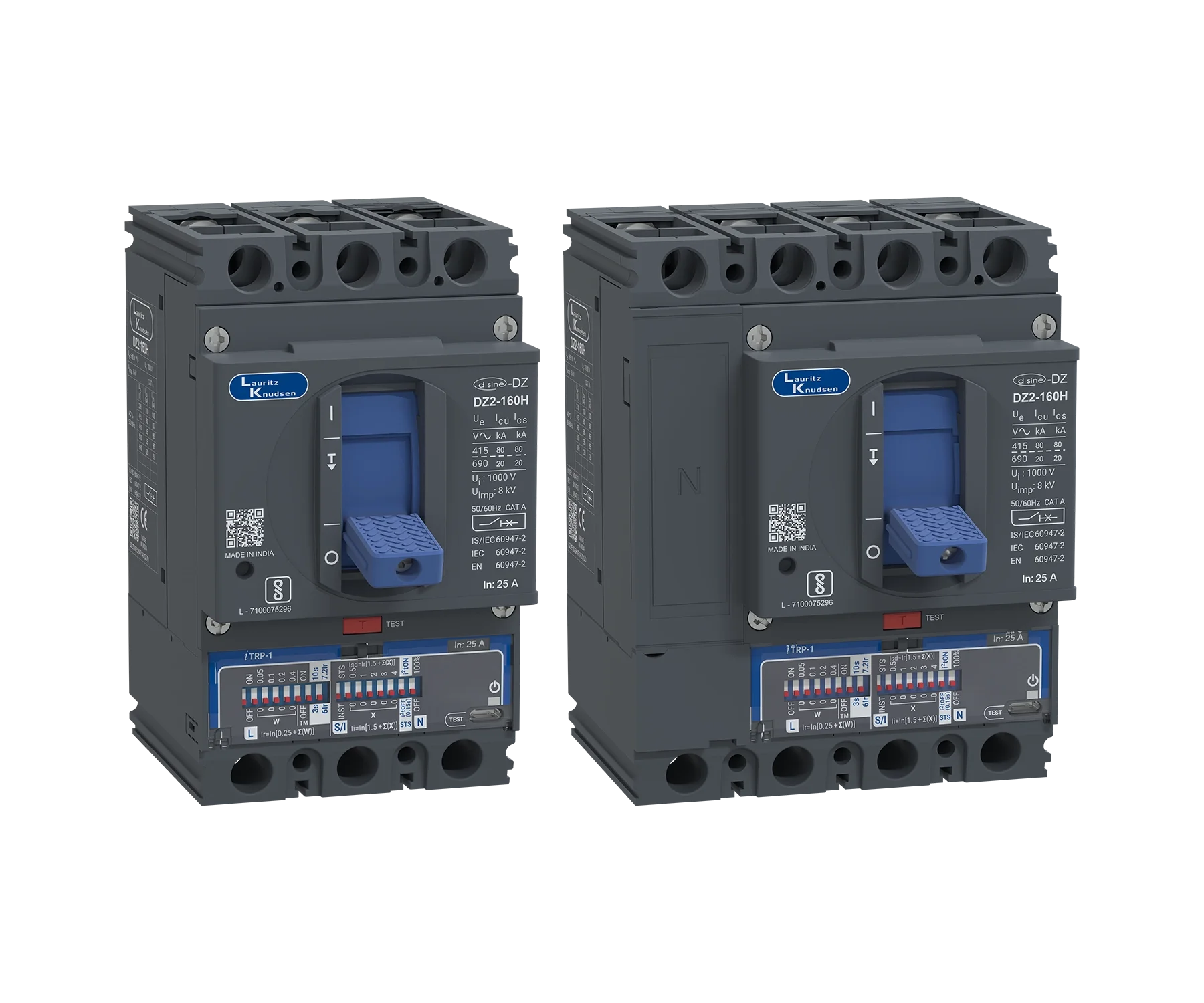
Phase barriers are made of dielectric materials which are non-hygroscopic in nature. Phase barriers are placed in slots provided in the MCCBs in between two phases. It increases the clearance between the two live phase terminals. The clearance by definition is the distance between two conductive parts, along a string stretched the shortest way between these conductive parts.

Now the medium between two live terminals is air. The breakdown voltage of air at normal temperature and pressure is 3kV/mm. The formula for breakdown capacity is
E = -dv/dx
The rated phase to phase AC voltage in 3ph supply is 415V. And “dx” is the inter-phase distance here. By introducing phase barriers, we increase the inter- phase clearance distance. So the ratio dv/dx reduces, thus making E far less than the breakdown voltage of air and hence makes the entire electrical installation safe & secure. The phase barriers in case of L&T have Class A insulation with dielectric strength of about 30kV/mm.
Advantage of using phase barriers

Maya Pai,
Deputy General Manager - Product Management & MarketingMaya Pai is a seasoned Product Management and Marketing professional with over 10 years of experience in the electrical industry, specializing in low-voltage switchgear and circuit protection solutions. Her expertise lies in Molded Case Circuit Breakers (MCCBs) and DC Portfolio management, encompassing product strategy, portfolio development, market analysis, and customer-centric innovation. She has worked extensively across the product lifecycle, translating evolving market and application requirements into competitive and reliable solutions for power distribution systems. Her experience spans conventional AC protection as well as emerging DC applications, supporting the growing demand for energy storage, renewable energy integration, EV infrastructure, and industrial DC power systems. Through her work and writing, she shares insights on switchgear technologies, circuit protection, DC systems, and the future of efficient, safe, and resilient power distribution.
Assistance Required?
Select an option to Contact Us

 Contact Us


