Technical Articles
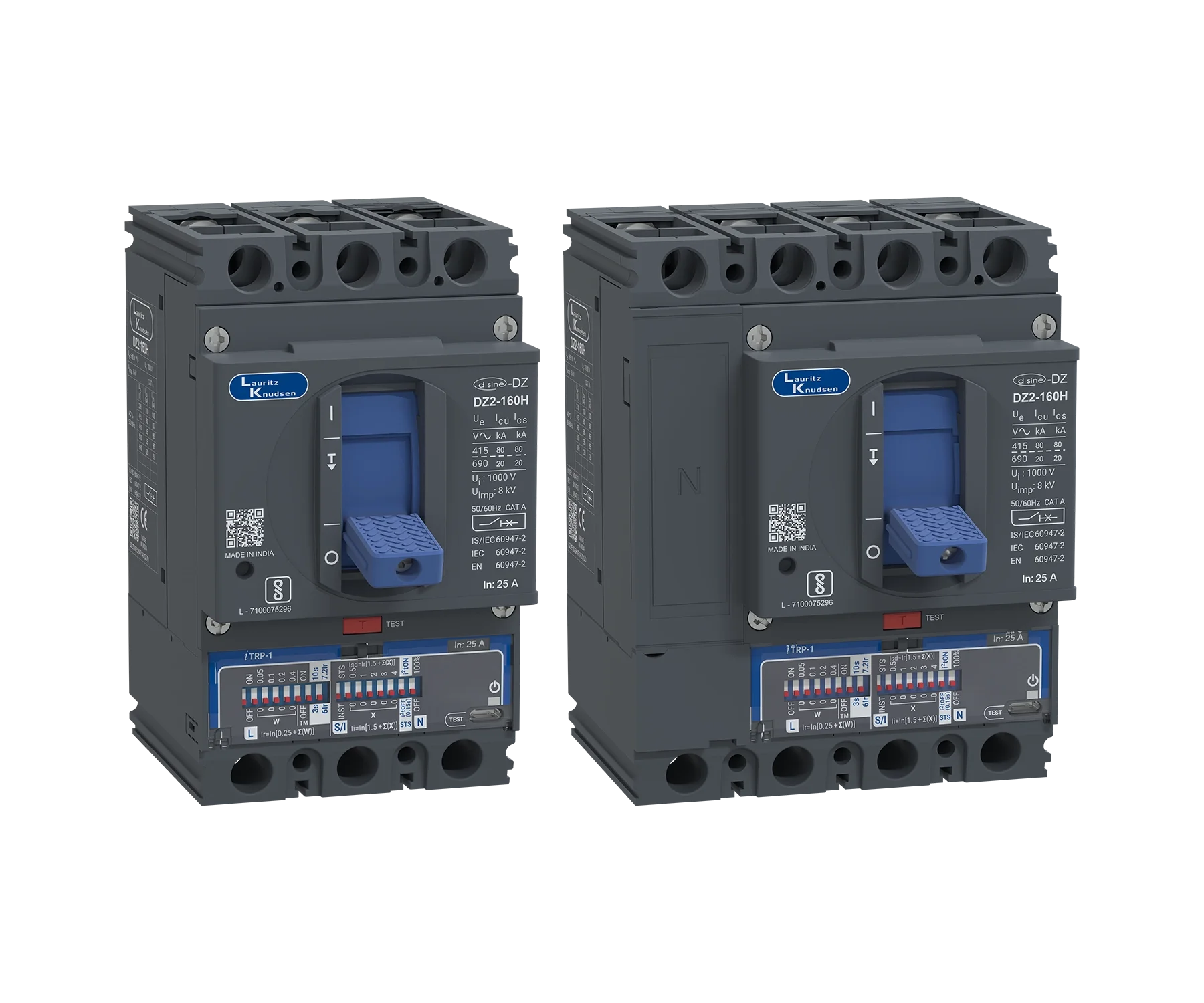
The switch-disconnectors are different from the circuit-breakers in the absence of the conventional protection unit. dsine MCCBs with Switch Disconnector version offer solution for switching various loads such as UPS, battery banks etc. with various advantages.
The main function of SD MCCBs is to provide isolation between two circuits. The position of the operating lever definitely corresponds with that of the contacts i.e. the knob of the MCCB indicates the true position of the contacts. Thus SD MCCBs are suitable for isolation.
SD MCCBs are suitable to make and break its rated current. They must be backed up by a Short Circuit Protection Device (SCPD) on the upstream to protect downstream loads / installations in case of any abnormal circuit conditions (overload / short circuit).
dsine SD MCCBs offer following advantages:
✓ Under-voltage release for Under-Voltage Protection
✓ Shunt release for remote tripping
✓ Stored energy motor operator for remote operation
✓ Auxiliary contacts for Status feedback
Depending on the rated operational current and the mechanical durability (A for frequent operation or B for infrequent operation), standard IEC 60947-3 defines the utilization categories as shown in the table below.
| Nature of current | Utilization Category | Typical applications | |
| Category A | Category B | ||
| Alternating current | AC-20A* | AC-20B* | Connecting and disconnecting under no-load conditions |
| AC-21A | AC-21B | Switching of resistive loads including moderate overloads | |
| AC-22A | AC-22B | Switching of mixed resistive and inductive loads, including moderate overloads | |
| AC-23A | AC-23B | Switching of motor loads or other highly inductive loads | |
Tests concerning the verification of the operational performances of equipment are intended to verify that the equipment is capable of making and breaking without failure, the currents flowing in its main circuit for the intended use.
The number of operating cycles and the test circuit parameters for the operational performance test for the various utilization categories are given below:
| 1 | 2 | 3 | 4 | 5 | 6 | 7 | 8 |
| Rated operational current Ie | Number of operating cycles per hours | Number of operating cycles | |||||
| AC and DC A Categories | AC and DC B Categories | ||||||
| Without Current | With Current | Total | Without Current | With Current | Total | ||
| 0 < Ie ≤ 100 | 120 | 8500 | 1500 | 10000 | 17000 | 300 | 2000 |
| 100 < Ie ≤ 315 | 120 | 7000 | 1000 | 8000 | 14000 | 200 | 1600 |
| 315 < Ie ≤ 630 | 60 | 4000 | 1000 | 5000 | 800 | 200 | 1000 |
| 630 < Ie ≤ 2,500 | 20 | 2500 | 500 | 3000 | 500 | 100 | 600 |
| 630 < Ie ≤ 2,500 | 20 | 2500 | 500 | 3000 | 500 | 100 | 600 |

Maya Pai,
Deputy General Manager - Product Management & MarketingMaya Pai is a seasoned Product Management and Marketing professional with over 10 years of experience in the electrical industry, specializing in low-voltage switchgear and circuit protection solutions. Her expertise lies in Molded Case Circuit Breakers (MCCBs) and DC Portfolio management, encompassing product strategy, portfolio development, market analysis, and customer-centric innovation. She has worked extensively across the product lifecycle, translating evolving market and application requirements into competitive and reliable solutions for power distribution systems. Her experience spans conventional AC protection as well as emerging DC applications, supporting the growing demand for energy storage, renewable energy integration, EV infrastructure, and industrial DC power systems. Through her work and writing, she shares insights on switchgear technologies, circuit protection, DC systems, and the future of efficient, safe, and resilient power distribution.
Assistance Required?
Select an option to Contact Us

 Contact Us


