Technical Articles
The ability of circuit breakers to operate only if the short circuit current is in a particular direction and refuse to operate when current is in the other direction is called directional short circuit protection.
A directional relay/protection release will operate only if the short circuit current is in a particular direction and is above a certain threshold value, called the pickup current.
We use directional relays/protection release where, if in the event of a fault, there is a possibility current reverses its direction and starts flowing in a direction opposite to its original direction.
Whenever there is an line-ground fault on the Transmission line, current from every possible source start feeding the fault, as it is in the path of the least impedance. It is pertinent to note that the load, if passive, will not feed the fault (Active Loads like Synchronous machines can act like synchronous generators)
Consider a parallel feeder system as shown in Figure 1A having two generators and one load. The system is in synchronism and running at the rated voltage and frequency. In the healthy condition, the current flows as indicated by the blue lines. Now suppose if a Line-Ground fault occurs at point A (Fig1B). Then, the current from all sources start feeding the fault. Circuit Breaker 3 senses the fault in its Zone of Protection and isolates the faulted line from the circuit while Circuit Breaker 4 does not trip. After isolating the faulted line, the circuit looks as follows:


Now it would seem that opening of circuit breaker 3 would isolate the faulty line and system would return to healthy state. But even after that, the short circuit fault current can keep flowing through the paths shown in figure 1C. This means that circuit breaker 4 would have to be opened as well. In cases like these, directional short circuit protection comes to our rescue.

If Circuit Breaker 4 could somehow trip by sensing that the direction of current that was previously passing through it in healthy condition has now reversed in faulty condition, our problem would be solved at once. That is exactly what directional short circuit protection offers. Circuit Breakers with directional short circuit protection sense that the direction of current is reversed and trip if the value is above a certain threshold (called the pickup point).
At this point, we are tempted to conclude that directional short circuit protection is quintessential at the feeder end. But if we take a step back, we can notice that this might not hold true when the load is an active load.

Directional Protection equipment come at a higher cost, so economic aspect also needs to be considered. The general practice followed is that directional protection is required wherever load/source current may reverse its direction in case of a fault occurrence. In our example, directional relays are required for CB2 and CB4.
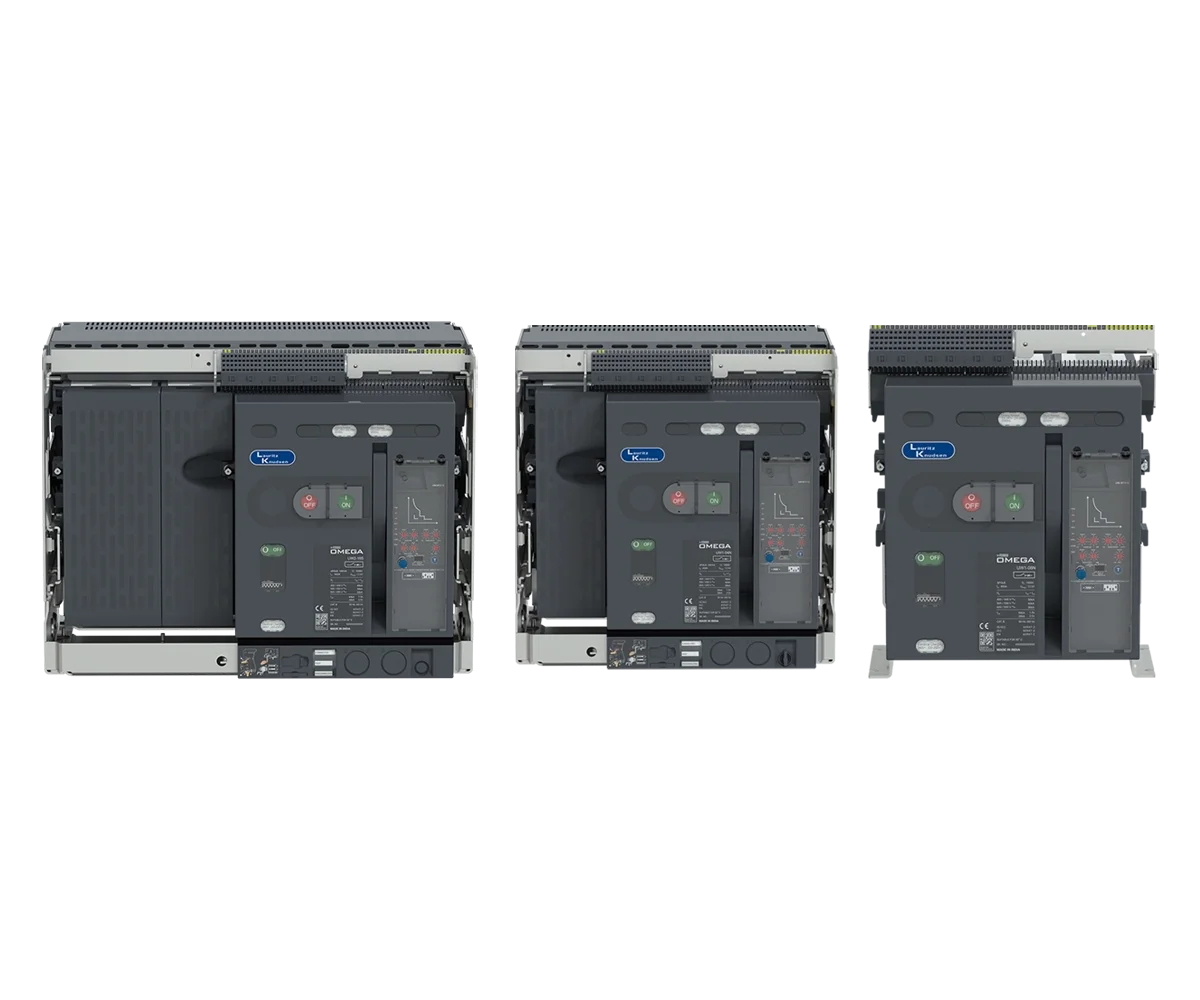
All Omega ACBs with Protection Release MTX3.5 and above are equipped with inbuilt Directional Short Circuit Protection with Pickup Value adjustable from 0.6 times to 12 times the rated current (adjustable in steps of 0.05). Time Delays of 20ms, 100ms, 200ms, 300ms, 400ms. A feature for Pre-trip alarm is also offered, with an adjustable setting of 0.5 to 0.95 times the short circuit current.
As a general practice, the time delay of the directional short circuit is kept lower than the normal short circuit protection. This ensures that the circuit breaker in which fault is flowing in the opposite direction trips first.
| Parameter | UW-MTX3.5 | UW-MTX3.5EC | UW-MTX3.5H | UW-MTX3.5H/4.5 | |
| Directional Short-Circuit | Protection: Enable/Disable | ✓ | ✓ | ✓ | ✓ |
| Direction: Top/Bottom | ✓ | ✓ | ✓ | ✓ | |
| I²t: ON/OFF | ✓ | ✓ | ✓ | ✓ | |
| Pick-up(Is): In x ... | 0.6 to 12 In in step of 0.05 | ||||
| Delay(ts) | 20-100-200-300-400 ms | ||||
| Pre-alarm | 0.5 to 0.95 in step of 0.05 x Is | ||||
| Cold Pick-Up ON/OFF | ✓ | ✓ | ✓ | ✓ | |
| Cold Delay | 100 ms 10s in step of 0.05 x Is | ||||

“The protection release shall offer feature of Directional Short Circuit to protect system from the Short Circuit faults in the reverse direction.”
| Feature | OMEGA | MTZ | NW | MVS | Emax2 | Emax | Formula | 3WL | 3WT |
|---|---|---|---|---|---|---|---|---|---|
| Directional Short Circuit | MTX3.5 onwards | Yes (Optional) | No | No | Ekip Hi-Touch | PR123 | No | ETU76B | No |

Sourav Dasmodak,
Product Management & Marketing (Powergear - ACB)Product Owner of Air Circuit Breaker (ACB) of Lauritz Knudsen for Domestic & International Market. I can talk to you about Electrical Products' Sales, Business Development, Market Expansion, Cracking Critical Strategic Account, handling Key Account & of course how to develop & motivate Channels along with the organizational growth. Having near about one and a half decade of experience across the country with major electrical manufacturers (Top 4).
Assistance Required?
Select an option to Contact Us

 Contact Us

