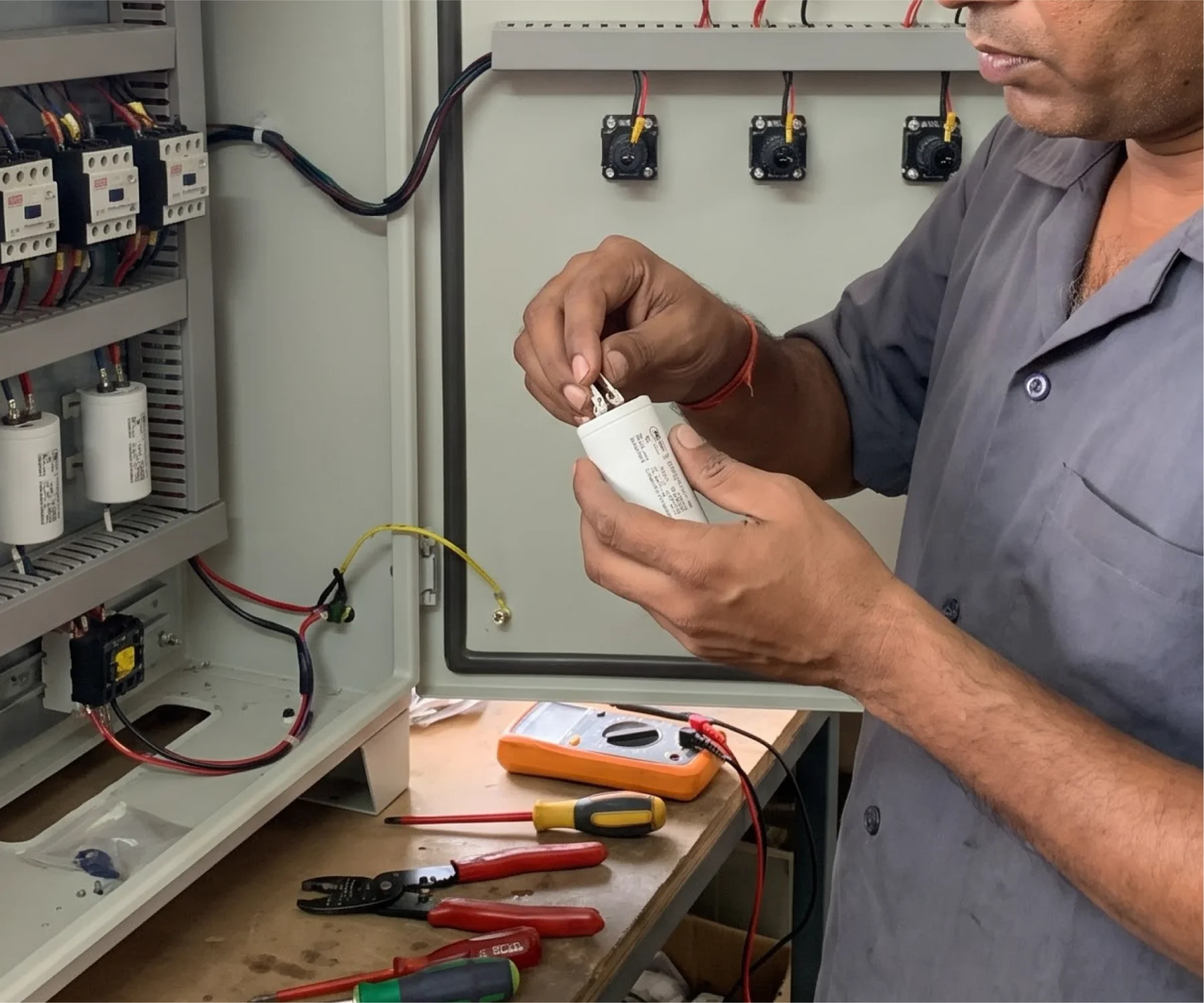
Capacitor Switching In APFC Panel

Capacitor Switching In APFC Panel
Updated: | 6 min read

Technical Articles

Table of Contents

Click on any topic to jump to that section

The switching of capacitor banks is a special and challenging task in Automatic Power Factor Correction (APFC) panels. The selection of appropriate switching device for such application is based on two criteria:


  • Ability to carry rated capacitor current continuously
  • Ability to withstand the peak-inrush current of capacitor

It is simple to calculate the capacitor rated current and select the switching device to be able to carry rated capacitor current (2.5 to 3 times the capacitor rated current to take care of overload, harmonics, supply voltage variation and capacitor value tolerance). However, it is a little difficult to select the switching device which is able to withstand the peak-inrush current. This is because the peak inrush current for capacitor switching application depends upon various factors such as:


  • The inductance of the network (including cables, switchgears and transformer)
  • The transformer power rating and percentage impedance
  • Method used for power factor correction

- Fixed capacitor bank

- Multi-stage capacitor bank with steps of equal ratings

- Multi-stage capacitor bank with steps of unequal ratings

In multi-stage capacitor bank, the numbers and rating of steps already switched on


In most of the installations, the multi-stage capacitor banks are used as steps of unequal ratings. The bigger steps of higher kVAr ratings being switched on initially and smaller steps are switched on periodically, for achieving the targeted power factor. In such cases, the value of inrush-current peak will be far higher and hence the smaller capacitors will be heavily stressed.

Capacitor switching can be done by various ways like:

Power Contactor

  • Normal power contactors simply allow the inrush current to flow through it. Because of this,contactors and capacitors are heavily stressed. So the contactor selection should be such that it withstands the heavy inrush current. Hence, power contactors need to be heavily de-rated.
  • This inrush current also stresses the power capacitors and may result in their premature failure.
  • Power contactors should be used along with inrush current limiting resistors, for reducing the magnitude of inrush current. However, this increases the cost & size of the APFC panel along with extra power losses.

Capacitor Duty Contactor

  • Capacitor duty contactors can be used to limit the inrush current to less than 10*IN
  • Capacitor duty contactors have pre-contacts/auxiliary contacts with current limiting resistors (of 4Ω. At the moment of switching, the pre-contacts (with resistors) close first. This reduces the inrush current to less than 10*IN. After a few milliseconds, main contacts are closed and the pre-contacts will open and go out of the circuit
  • Capacitor duty contactors are employed where the frequency of switching is less i.e., the load fluctuation is not very fast. The capacitor requires atleast 60 seconds to discharge to a nominal value (50 V). So capacitor duty contactors cannot be used when load fluctuation is heavy

Thyristor Switching Module (TSM)

  • TSM is a static switching device that is used specially for switching capacitors (dynamic power factor correction), wherever the load fluctuation is heavy (like welding, steel rolling, etc.)
  • Rapid switching (5 ms to 20 ms) is possible with TSM along with Quick Discharge Resistor (QDR)
  • There is no inrush current while using TSM (zero voltage switching). So frequent switching does not affect the life of capacitors and there is no need for extra current limiting resistors
  • TSM has thermal cutoff, which switches off the module when temperature exceeds beyond a certain limit. It automatically switches on when optimum temperature is attained

About the Author

author

Rajesh R Shirodkar,

DGM-Corporate Communication

Rajesh Shirodkar is a seasoned marketing and business leader with over 20 years of experience in the automation and electrical industry, spanning marketing communications, sales, business development, and software solution selling. He has led successful brand transformation initiatives and high-impact marketing programs, including branding and account-based marketing campaigns, as well as industry events that drive visibility, engagement, and growth. With expertise in brand building, lead generation, solution selling, and sales enablement, Rajesh is known for translating technology and business offerings into compelling value propositions and delivering sustainable growth through strong stakeholder collaboration.

Assistance Required?

Select an option to Contact Us
contact-sales
Contact Sales
product-sales
Contact Support