Technical Articles
Busbar Trunking System (BBT) performs the function of transporting current form one point to the other. Traditionally cables were used for this function. BBT goes beyond what cables do. BBT can tap off power to switchgear for further distribution using Plug-in boxes (PIB) or Tap-off boxes (TOB). In comparison to cables, PlB/TOB of BBT can thus serve as distribution panels at different stages (e.g. at floors of a building). BBT thus continues as single systems to replace cables as well as incomer distribution boards at floor level for building (Residential or commercial). The BBT system offer a superior alternative to cables and other bus trunking options through this compact and scalable range of system thus providing an enhanced solution to power transmission and distribution in buildings as well as industry. The below mentioned table shows the advantages of using a Busduct system over the cable system.
| Table 1 – Technical Comparison of Sandwich busduct Vs Cables | |||
|---|---|---|---|
| Factor | Cable | BBT | Comparison |
| Safety | Less | More | SC withstand capacity, Protection against fire |
| Space required | Large | Small | Single run for multiple circuits |
| Flexibility to Requirements | No | Yes | Load can be added and adjusted on the existing system |
| Service Life | Low | High | Average service life is >20 years |
| Mechanical Strength | Low | High | Metal Enclosure |
| Installation Cost | High | low | Shorter installation time, less support and space required |
| Maintenance Cost | High | low | Maintenance free system |
| Aesthetics | Poor | Good | Compact in size and well finished surface |
A Busduct System is an assembly comprising a system of conductors with one or more bars separated or / and supported by insulating material and contained in a conduit or similar casing. There are mainly two types of busduct systems based on the type of construction: Air-insulated and Sandwich.
An air-insulated busduct construction has air as an insulation between conductors, hence the overall size of this type of busduct is more compared to a sandwich busduct.
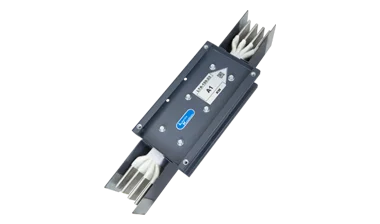
A Sandwich Busbar Trunking System (BBT) is manufactured as a totally enclosed, pre-fabricated sections consisting of copper or aluminum busbars.
Power is simply tapped off by PIB / TOBs positioned at required intervals. A sandwich busduct system will consist of Straight lengths (Power transmission & distribution), Flange ends (for incoming connection), Elbows (for routing direction), End feed box (for isolation between cables & BBT), End cover (for terminating the route), PIB/TOB (for distribution) and other accessories. The below mentioned table shows the comparison of Sandwich type BBT v/s Air Insulated BBT
| Table 2 – Technical Comparison of Sandwich busduct Vs Air Insulated busduct | |
|---|---|
| Sandwich Busduct | Air Insulated Busduct |
| Compact Size | Size typically more than 3 times of Sandwich Busduct |
| Don’t have air gap and tested for fire related tests | Enclosure with large air gap hence fire can spread easily due to chimney effect |
| Joints are with single bolt. Quick installation possible | Joints are made with multiple bolts, takes longer time for installation |
| Less installation material & cost | More installation material & cost |
| Plug-in type boxes can be installed & removed easily; even when riser is Live | Bolt-on type boxes takes longer time; not possible to install when riser is Live |
| Higher fault level withstand capacity | Much limited fault level withstand capacity due to supports construction |
| Lesser voltage drop @0.8 p.f. | Higher voltage drop @0.8 p.f. |
As we can see from above the sandwich busbar trunking system has several key advantages over conventional forms of power distribution:
Sandwich busbar trunking system (BBT) is a compact design and an efficient, safe and ideal system for power distribution to industrial installations and high rise building structures, offering a wide current range from 250A to 6300A in Aluminum / Copper conductors. Power can be tapped by means of PIB / TOB fitted with SCPD (16A - 1250A). The system can have a provision of maximum 5 Plug-in outlets combined on both sides per 3 meters length, which can be fitted quickly and provides total flexibility for any change in distribution layout.
Tap-off Units (TOU): There are 2 types of TOUs:
Various kinds of insulating materials are used in Sandwich type BBTs. The commonly used Insulation are Class-B (130°C) and Class-F (155°C).
Many times it is observed that various class of insulation are combined to achieve higher class but as per standard when various class of Insulation are combined the insulation of lowest class is only considered.
Sandwich BBT need to comply with Clause No. 10.10 of IEC 61439-1 / 6 which states the temperature rise limits permissible for Copper BBT over an ambient of 35°C which are indicated below (Source: IEC 61439-1 Table No-6 & IEC 61439-6)
| Table 3 – Temperature rise limit for Copper & Aluminum Busbar | ||
|---|---|---|
| Temperature limit | Copper | Aluminium |
| Enclosure | 55°C | 55°C |
| Termination | 70°C | 70°C |
| Joint/Busbar | 105°C | 90°C |
Considering the ambient temperature of 35°C as per IEC 61439 standard, temperature rise allowed on Joints is 105°C that means total temperature can go up to 140°C (35+105) in case of Copper busduct and up to 125°C (35+90) in case of Aluminium busduct, hence Class-B insulation will not withstand the full temperature in case of Copper busduct and has very limited buffer in case of Aluminium busduct, whereas Class-F insulation will have safer buffer of 15°C (155°C-140°C) even in case of Copper busduct.
Following are the types of BBT layouts;
Transformer / DG to LV Panels: One of the most frequently used routes. It connects the Transformer / DG to LV Panel. It is usually a simple route with very less complications. Majority of the times this route will be IP66 (outdoor) type with canopy since the transformer is placed in an open area.
LV Inter Panel Connection: It connects the outgoing feeder of 1st panel to incoming of 2nd panel. This route will be indoor (IP4X/5X) since LV panels will be kept in dedicated rooms. This is also referred as Feeder busduct and has no tapping points.

Horizontal Power Distribution: This method is normally used in industries, Data centers, warehouses where power received from BBT is horizontally distributed in different sections. Power distribution system routes will be installed indoor and it can possibly have multiple Tap-off points in segments like industries, Data centers, etc. throughout its length.

Vertical Power Distribution (Riser): This method is used in high rise residential / commercial office or IT buildings where power received from BBT is vertically distributed in different outgoing feeders at floor level. This route will be installed in electrical shaft and it will have multiple Tap-off points at floor levels.

2 ways in which vertical riser arrangement can be achieved;


We have seen the ways how power can be distributed horizontally & vertically. In industries, Data centers power is rarely monitored at each Tap-off unit level, but in case of Residential or Commercial buildings it is required to monitor the Power for each tenant. Power monitoring is possible in Busduct routes using Meters in different ways. Following are the methods used for metering;
Commercial Buildings: In commercial buildings, metering is generally used by single entity who is the owner/developer and the tenants pay utility bills to owner/developer. The owner/developer pays the single energy bill to the utility service provider for the actual consumption. To ensure that all the required cost incurred is taken into account owner/developer uses an energy monitoring system in their premises.
BBT is used In Commercial installations for providing power to entire floor or divide the same to each client if needed on each floor. In this, normally sub metering is done and hence utility meters are rarely used but on the contrary panel mounted meters are preferred which are communication capable.
Normally these meters communicate on RS-485. It is also possible to integrate the metering in BBT Tap-off units as seen below. The advantage of metering inside TOU is that it saves space for additional metering panel.

In recent times, a new trend of Franchisee metering is observed where in the infrastructure would be provided by the developer, billing is directly charged and paid by the tenant to the utility. Further, there would likely be a separate arrangement between the utility provider and the developer.
Residential Buildings: In residential buildings, metering is normally done by utility company and hence metering is in utility company’s scope. Following methods of power distribution are generally used in residential buildings. Meters are used with CT.


From the above note, it is clear that Sandwich type BBT is more preferred over conventional methods of cables and Air Insulated busducts as it offers safer, reliable and energy efficient power distribution solution.
Sandwich type BBT as a system is very efficient which provides more safe, convenience and reliable power distribution vis-à-vis other power distribution systems.
Sandwich busducts can be used in various segment applications with different type of layout and even metering is possible with different options.

Sourav Dasmodak,
Product Management & Marketing (Powergear - ACB)Product Owner of Air Circuit Breaker (ACB) of Lauritz Knudsen for Domestic & International Market. I can talk to you about Electrical Products' Sales, Business Development, Market Expansion, Cracking Critical Strategic Account, handling Key Account & of course how to develop & motivate Channels along with the organizational growth. Having near about one and a half decade of experience across the country with major electrical manufacturers (Top 4).
Assistance Required?
Select an option to Contact Us
 Contact Us

