Technical Articles
A thermal overload relay is a motor protection device designed to prevent damage caused by prolonged overcurrent and overheating. It monitors motor current and responds to the heating effect caused by sustained overcurrent (I²R heating). The device helps protect motor windings, improve equipment reliability, and reduce maintenance costs. This guide explains the working principle, functions, applications, advantages, and limitations of thermal overload relays.
Thermal overload relays are typically selected based on the motor full-load current and the required trip class (such as Class 10, 20, or 30), depending on the motor's starting characteristics.
Spend enough time around motors, and you will eventually hear a maintenance engineer say something like, "The motor was fine yesterday."
That's usually how the story begins.
The motor wasn't defective. The wiring wasn't damaged. Yet something happened. A conveyor jammed. A pump started working harder than normal. A fan motor struggled under an unexpected load. The motor kept running, drawing more current and generating more heat until protection stepped in or didn't.
Motors rarely fail without warning. They usually show signs of stress long before serious damage occurs.
This is exactly where thermal overload relays become valuable. They sit quietly inside motor control systems, watching current levels and responding when operating conditions become unsafe. Most days, they do nothing. On the day they are needed, however, they can save a motor, production time, and a considerable repair bill.
When a motor operates beyond its rated capacity, it draws additional current. That additional current generates more heat within the motor windings. If this condition continues, insulation deteriorates and motor life is reduced. A thermal overload relay exists to trigger a trip that causes the contactor to disconnect the motor before real damage occurs.
Unlike fuses or circuit breakers that primarily respond to short-circuit and fault currents, overload relays protect against sustained overcurrent conditions.
They follow an inverse time-current characteristic, allowing temporary current surges (such as during motor starting) while responding to sustained overloads. Thermal overload relays are not designed for instantaneous fault protection and must always be used together with short-circuit protection devices such as fuses or circuit breakers.
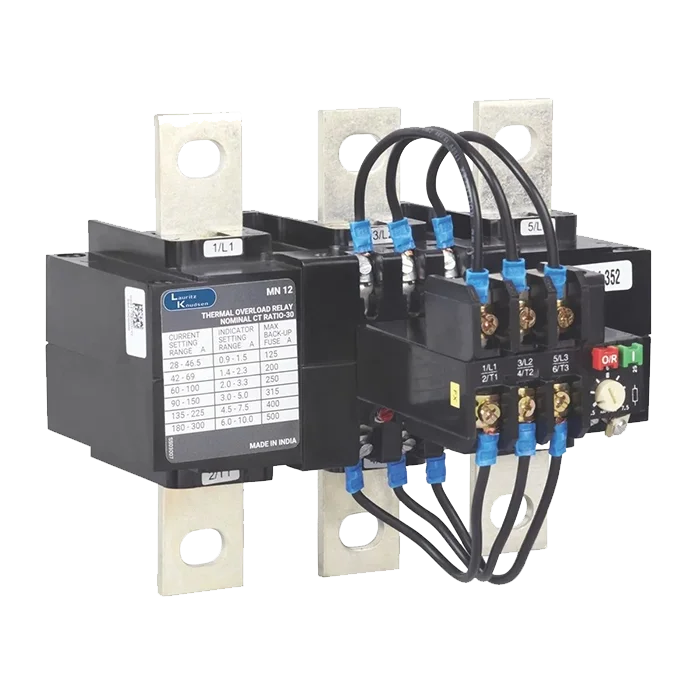
Today, overload relays are commonly installed alongside contactors in motor starter assemblies. Lauritz Knudsen Electrical & Automation offers solutions, including MN Thermal Overload Relays, RTO Thermal Overload Relays, and REO Electronic Overload Relays, for a wide range of motor protection requirements.
A lot of people assume overload relays simply switch motors off. This is technically true. But it doesn't tell the full story. Their real contribution is in protecting equipment from conditions that often develop slowly and quietly before anyone notices a problem.
Motors draw different amounts of current depending on their mechanical load. The primary function of a thermal overload relay is detecting abnormal current levels through their heating effect before damage occurs. This helps prevent prolonged overheating of motor windings and insulation.
Motor insulation doesn't usually fail overnight.
Damage accumulates over time. Repeated exposure to high temperatures gradually weakens insulation materials. This happens until failure eventually occurs. One important role of a thermal overload relay is to help prevent gradual deterioration by limiting the duration of overload conditions.
Replacing a relay is relatively inexpensive. Replacing a large industrial motor is not.
When overload protection trips early, it often prevents damage that would otherwise require costly repairs, extended downtime, or even complete motor replacement. That's why many maintenance teams consider overload relays a small investment with a surprisingly large payoff.
Every protective device inside a motor control panel has a specific job.
The operating concept is actually easier to understand than many people expect. Traditional thermal relays operate based on heat, though their response follows predefined time-current characteristics (trip classes).
The thermal overload relay working principle begins with Joule heating.
Motor current flows through heater elements or bimetal strips, generating heat proportional to the current (I²R). During sustained overload conditions, the generated heat gradually increases.
Traditional thermal overload relays operate based on this heating effect, with their response determined by predefined inverse time-current characteristics (trip classes).
Traditional overload relays rely on a bimetallic strip made from two different metals bonded together.
Each metal expands at a different rate when heated. As the temperature rises, the strip bends. The greater the overload, the faster the movement. It's a remarkably simple mechanism that has protected motors for decades.
Understanding how thermal overload relay works becomes much easier once the bimetal strip starts moving. An auxiliary contact changes state, causing the contactor coil to de-energise and disconnect power from the motor by opening the contactor.
After a trip occurs, the relay needs time to cool.
Some models reset automatically. Others require hands-on intervention. Many facilities actually prefer manual reset because it encourages technicians to investigate the reason for the overload before restarting equipment and risking another trip event.
Walk through almost any industrial facility, and you will find motors performing critical tasks. Where motors exist, overload protection usually isn't far away.
Conveyors rarely operate under perfect conditions. Material builds up. Rollers seize. Belts slip. Mechanical resistance increases. One of the most common applications of thermal overload relay protection is preventing conveyor motors from overheating when these conditions place additional stress on the drive system.
Pump motors regularly experience changing operating conditions throughout the day. Pressure fluctuations, flow restrictions, and process variations can all increase motor load unexpectedly. Overload relays help protect these motors from prolonged overcurrent conditions that may otherwise pass unnoticed until serious damage occurs.
Large commercial buildings depend heavily on motor-driven equipment. Fans, compressors, cooling towers, and circulation pumps frequently operate for long periods. Thermal protection helps ensure these motors remain protected when operating conditions become more demanding than originally anticipated.
Among the various applications of thermal overload relay devices, manufacturing equipment protection remains one of the most important. Production machinery often experiences fluctuating loads throughout normal operation. Reliable overload protection helps minimise downtime, reduce maintenance costs, and improve equipment service life in demanding industrial environments.
Technology has changed dramatically over the years. Yet overload relays remain common in motor control systems. There are good reasons for that.
Maintenance personnel generally appreciate equipment that is easy to understand. Overload relays rely on simple thermal principles rather than highly complex electronics. This simplicity frequently translates into dependable operation and easier troubleshooting when issues arise.
Not every application needs sophisticated electronic monitoring systems. For many installations, thermal overload relays provide effective protection without significantly increasing project costs. They deliver a practical equilibrium between performance and affordability.
Modern motor control systems are often designed around contactors and overload relays working together. Products such as MN Thermal Overload Relays, RTO Thermal Overload Relays, and REO Electronic Overload Relays from Lauritz Knudsen Electrical & Automation are specifically developed to complement motor starter assemblies and simplify installation.
These devices frequently remain in service for a long time. In well-maintained installations, overload relays can operate reliably for years. Their proven design continues to make them a dependable component within industrial motor protection systems internationally.
Despite their advantages, overload relays aren't the answer to every protection challenge. Engineers need to understand their limitations, too.
This is probably the most important limitation. Overload relays are not designed to interrupt fault currents associated with short circuits. They must always be used alongside suitable protective devices such like fuses or circuit breakers.
Ambient temperature can influence relay behaviour, although many modern thermal overload relays include temperature-compensation features to minimise these effects.
Thermal relays intentionally respond gradually. This characteristic prevents nuisance tripping during motor starting. However, it also means response times can be slower than modern electronic protection devices under certain operating conditions.
Thermal overload relays are specifically intended for overload protection. They do not provide protection against conditions such as short circuits, earth faults, or severe phase imbalance unless specifically designed to perform those functions.
Also Read: How Contactors and Overload Relays Work Together for Motor Protection
Thermal overload relays remain one of the most widely used methods of protecting electric motors against sustained overload conditions.
By responding to the heating effect caused by prolonged overcurrent, they help prevent insulation damage and extend motor service life. However, they should always be coordinated with short-circuit protection devices such as circuit breakers or fuses to provide complete motor protection.
Lauritz Knudsen Electrical & Automation offers a comprehensive range of motor protection solutions, including MN Thermal Overload Relays, RTO Thermal Overload Relays, and REO Electronic Overload Relays, designed to work seamlessly with contactors and motor starters across industrial applications.
Understanding the difference between relay and contactor helps industries select equipment that matches actual operational requirements rather than simply choosing devices based on appearance or terminology. In reality, using the wrong switching device can affect both safety and system reliability.
Not directly. Low voltage can lead to increased current draw in motors, which may result in overheating over time. Dedicated
undervoltage protection devices are required where low-voltage protection is necessary.
The motor may be experiencing hidden mechanical resistance, improper loading, bearing issues, or process-related conditions that increase current draw.
Settings should be verified during routine maintenance, motor replacement, system modifications, or whenever operating conditions change significantly.
It depends on the application. Electronic relays generally offer additional monitoring features, while traditional thermal relays remain cost-effective and highly reliable for many installations.
A thermal overload relay diagram helps technicians check wiring connections, understand contact arrangements, and guarantee proper integration with contactors and motor control circuits.

Rajesh R Shirodkar,
DGM-Corporate CommunicationRajesh Shirodkar is a seasoned marketing and business leader with over 20 years of experience in the automation and electrical industry, spanning marketing communications, sales, business development, and software solution selling. He has led successful brand transformation initiatives and high-impact marketing programs, including branding and account-based marketing campaigns, as well as industry events that drive visibility, engagement, and growth. With expertise in brand building, lead generation, solution selling, and sales enablement, Rajesh is known for translating technology and business offerings into compelling value propositions and delivering sustainable growth through strong stakeholder collaboration.
Assistance Required?
Select an option to Contact Us

 Contact Us

