Technical Articles
Power factor is the cosine of angle between the voltage sine wave and the current sine wave. It is the ratio of True power (kW) to Apparent Power (kVA).
Power Factor (PF) = kW/kVA
Depending on which value of voltage and current we consider, there are different types of power factors:
1) Displacement PF - The power factor which is due to the phase shift between voltage and current at the fundamental frequency is known as displacement power factor.
Displacement PF = P/(V1I1)
2) Distortion PF - The power factor which includes the effect of harmonics present in the system is called distortion power factor.

3) True PF - It is defined as the ratio of average power to apparent power. Both the above power factors together combine to form the True power factor.
True PF = Displacement PF x Distortion PF
True PF = P/VrmsIrms
Understanding the various types of power factor is very important because all three have different implications.
True PF = Displacement PF x Distortion PF
Power factor improvement methods using capacitors will help to improve displacement pf. However, if the system is polluted by harmonics, it will reflect in lower distortion power factor. True power factor is the product of displacement and distortion power factor.[1]
Harmonic levels are measured as Total Harmonic Distortion (THD). Higher THD implies lower distortion PF. The graph here depicts the impact of THD levels on the true power factor of nonlinear loads.

The following table shows how different types of power factor vary with THD.
| THD-I | Displacement PF (assumed to be compensated by equivalent Capacitors) | Distortion PF | True PF |
|---|---|---|---|
| 5% | 0.999 | 0.999 | 0.998 |
| 30% | 0.999 | 0.958 | 0.957 |
| 40% | 0.999 | 0.929 | 0.928 |
Overall, it will reflect in lower pf value. Hence, even if the displacement PF is corrected up to unity, the true PF will remain low because of poor distortion PF.
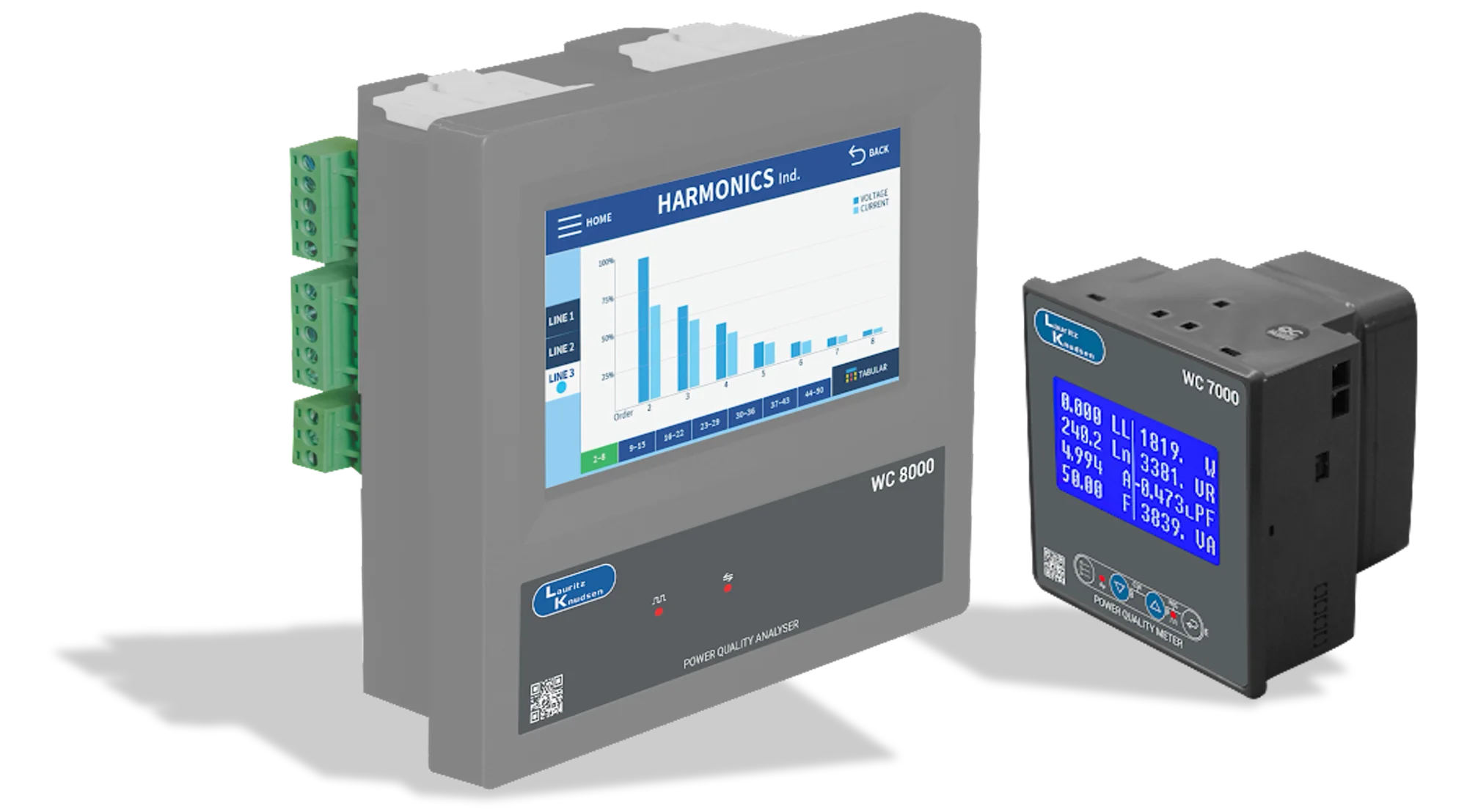
Our Digital panel meters have the flexibility to display displacement PF as well as True PF.
Digital Panel meters offers selection of PF types by means of VA selection methods. To achieve this, enter in programming mode of DPM and drill down to VA selection option.

To display Displacement PF, select Vector Harmonics VA. Factory default is vector harmonics method.

To display True PF, select Arithmetic VA.
Arithmetic VA=Voltage*Current
APFC panels with detuned filters can effectively increase the displacement PF to unity. But true power factor will remain low due to low distortion PF. Thus, to improve distortion PF, Active Harmonic Filter should be used to mitigate harmonics.[1]
Monitoring of displacement or true power factors can be achieved using L&T Electrical & Automation’s Digital Panel meter series using the above selection method. To continuously monitor these, SmartComm EMS is recommended along with a host of other energy management benefits.
[1] L&T Electrical & Automation's VArticle Issue 33 - Harmonics and its impacts on power factor - Distortion Power Factor

Divyesh B. Vaghasiya,
Senior Product Management and Marketing professionalDivyesh B. Vaghasiya is a Senior Product Management and Marketing professional focused on Industrial IoT, Energy Management, and Smart Technologies. With 13+ years of experience in the electrical and automation industry, he combines deep technical knowledge with strategic business thinking. He shares perspectives on emerging technologies, product management, sustainability, and digital transformation, helping businesses navigate the evolving energy landscape.
Assistance Required?
Select an option to Contact Us

 Contact Us

