Technical Articles
Thermal Expansion is a general phenomenon applicable to all metals wherein due to temperature variations thermal expansion and contraction takes place. Therefore due importance is given at the design stage to accommodate it.
The extent of thermal expansion depends upon the conductor / enclosure material (property: coefficient of thermal expansion) and its operating temperature.
Coefficient of linear expansion for copper = 16.5 x 10⁻⁶ /°C
Coefficient of linear expansion for Aluminium = 22.2 x 10⁻⁶ /°C
Coefficient of linear expansion for Galvanized Iron = 11.8 x 10⁻⁶ /°C
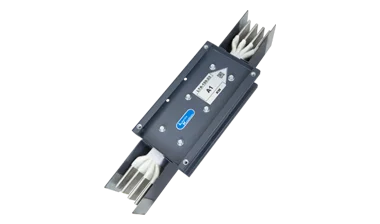
Construction of S-Line BBT is as shown in the fig. 2 of Annexure-

Multiple BBT units are connected to each other through a unique joint block system as shown in the fig. 3 of Annexure-1. Unlike in conventional joint block, in S- Line joint block, bolt does not pass through busbar.
In the uni-block joint design conductors are clamped but not restricted to move. The care has been taken while designing this joint block system that there is no possibility of stress building up which may damage the conductors due to taking wedge shape if restricted to move, on event of expansion. The design of this uni-block joint allows conductors to move up to 6mm towards the joint centre from both sides, i.e. each joint can absorb a total of 12mm of expansion (Fig. 3 of Annexure-1). This uniquely designed joint system allows free movement of the conductor and doesn’t let conductors experience any thermal or mechanical stresses developed.

Longitudinal expansion is important since it can lead to slip in the joint followed by loosening. It is important that long bars are provided with a flexible element to absorb movement due to thermal expansion. In the case of long runs of straight conductors it is recommended that expansion joints should be introduced. This expansion joints have flexible conductors (copper braids) connected to ends of two BBT units, This type of joint has the advantage that it can accommodate expansion in more than one direction (in most cases three directions) and also tends to eliminate vibration forces being passed from one unit of equipment to another. See fig. 4 of Annexure-1.
This specially designed accessory has flexible braid wires which on event of longitudinal expansion forms a loop of wire and allows conductor expansion to take place. This expansion joint accessory of S-Line is capable of accommodating 28mm of expansion which is in addition to the capacity of each joint block which allows a movement of 12mm per joint block. In S-Line BBT it is recommended to use expansion joint after every 40 meters of BBT run when installed horizontally.
Another advantage of expansion joint is, when any BBT installation is crossing the building expansion joint, this accessory becomes an essential unit of BBT at that location to accommodate BBT enclosure’s physical movement. For this purpose, expansion joint has a telescopic design wherein two telescopically fitted enclosures which give an enclosure level displacement of 30mm.

Case study for S- Line range at Maximum allowed temperature rise as per IEC61439 Part-1 & 6
and for maximum width of the busbar:
Conductor material = Aluminium
Length of the conductor = 1000 mm
Maximum width of conductor = 250mm
Co-efficient of thermal Expansion = 22.2x10⁻⁶/°C
Ambient Temp = 20°C
Maximum working temperature allowed as per standard = 125°C
Recommended interval for expansion joint = 40 m
A = Maximum longitudinal expansion possible = 93.24 mm (2.33mm x 40m)
Number of joint blocks = 13
Expansion accommodation at each joint block = 12 mm
B = Total scope available in design to accommodate expansion at joint blocks = 12 x 13 = 156 mm
Design is safe as B > A
A = Maximum lateral expansion possible in S-Line BBT = 0.58 mm
B = Space available in design to accommodate expansion = 2.5 mm
Design is safe as B > A
In addition to individual joint blocks; further safety design margin of 28 mm has been provided in expansion joint accessory. Another advantage of expansion joint is, when any BBT installation is crossing the building expansion joint, this accessory becomes an essential unit of BBT at that location to accommodate BBT enclosure’s physical movement.
Note:
| Supporting Condition | Branching | Fig. | Length (L) which needs no expansion unit |
|---|---|---|---|
| Both ends free | Branched at each storey | 1 | 120 (m) |
| One end free | Branched at each storey | 2 | 90 (m) |
| One end fixed | Not branched | 3 | 60 (m) |
| Both ends fixed | Branched at each storey | 4 | 60 (m) |


Sourav Dasmodak,
Product Management & Marketing (Powergear - ACB)Product Owner of Air Circuit Breaker (ACB) of Lauritz Knudsen for Domestic & International Market. I can talk to you about Electrical Products' Sales, Business Development, Market Expansion, Cracking Critical Strategic Account, handling Key Account & of course how to develop & motivate Channels along with the organizational growth. Having near about one and a half decade of experience across the country with major electrical manufacturers (Top 4).
Assistance Required?
Select an option to Contact Us

 Contact Us

